What ROI from OpenClaw actually measures
Most ROI calculators for AI tools ask you to count hours. How many emails drafted per week? How many minutes saved per task? The result is a number like "7 hours saved per month" — plausible, forgettable, and wrong.
The hours are real. They are not where the money is.
| What founders track | What actually drives ROI |
|---|---|
| Hours saved per week | Leads responded to within 2 hours |
| Tasks automated | Proposals that received a follow-up |
| Emails drafted | Invoices collected before 45 days |
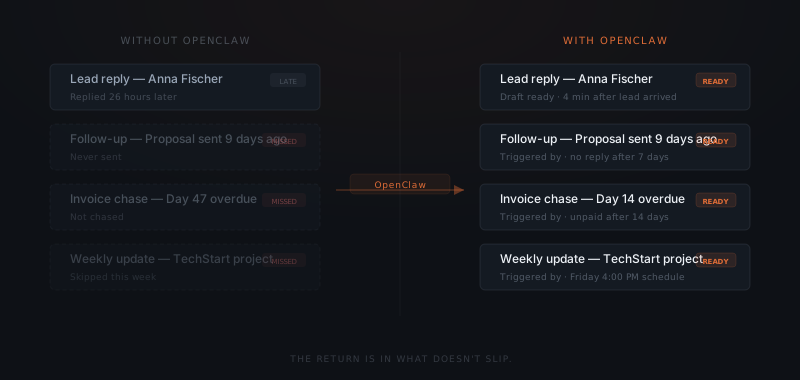
The money is in the lead that got a reply in 90 minutes instead of 26 hours. The client who received a status update before they had to ask. The invoice chased on day 31 instead of day 47. Each one either happened or it did not. The difference is not time saved — it is a deal, a relationship, or a payment.
Three places OpenClaw ROI shows up first
OpenClaw does not replace your judgment. It closes the gap between your judgment and your action. You still make every decision — the agent makes sure you make them before the window closes.
Lead follow-up is the clearest case. Reply within two hours and you are still in the conversation. Reply the next morning and it has moved on. For a €5,000 contract, one deal saved pays for months of service. OpenClaw drafts the reply the moment the trigger fires. The message is waiting in Slack for your approval before you open the thread.
Client retention is less visible but larger in aggregate. Most clients do not leave with a complaint — they drift. Fewer replies, slower responses, a feeling the agency is too busy. A weekly update that reliably arrives. A check-in that happens without prompting. In a service business, those are not nice-to-haves — they are what the client is paying for.
Invoice collection is the most direct calculation. If your invoices run 30+ days late, OpenClaw chases them on the configured day. The recovered revenue is easy to count. One recovered €3,000 invoice per quarter is €12,000 per year.
What to track in the first 30 days with OpenClaw
The ROI isn't in hours saved. It's in deals that didn't die.
You do not need a dashboard. You need three numbers.
Lead response time — From the moment an inbound lead arrives to the moment they receive a reply. Before OpenClaw: hours or days. After: minutes, because the draft is in your Slack approval channel before you have opened your inbox.
Follow-up rate — Of the proposals or check-ins that needed a follow-up this week, how many went out? Before: whatever you remembered. After: all of them. OpenClaw flags each one at the right moment and drafts the message.
Invoice aging — How old is your oldest unpaid invoice? How many days pass between issue and first chase? OpenClaw sends the reminder on the configured day, without prompting.
Measure these three before you start. Measure them at day 30. The delta is your ROI.
The OpenClaw ROI calculation
OpenClaw starts at €500 per month — €6,000 per year at the base tier.
Break-even at that cost requires roughly two €3,000 deals per year that would otherwise have slipped. That is not a high bar. It is two warm leads who got a reply fast enough to stay engaged. Two proposals that got a follow-up before the prospect went cold.
At the Growth tier (€800/month), the threshold is two €4,800 deals per year. At Scale (€1,200/month), three. In each case, the break-even assumes zero contribution from client retention or invoice recovery. Add those and you are already past it.
The moment most founders see OpenClaw ROI
The ROI calculation is accurate. It is not usually what convinces founders.
What convinces them is the draft that appears in Slack on a Thursday morning. A follow-up to a prospect they had forgotten. The prospect has been sitting on a proposal for nine days. The draft is professional, references the original conversation, asks a simple question. You approve it in 30 seconds. The prospect replies that afternoon.
That deal does not appear in a time-saved metric. It appears in your closed-won column.
The founders who see the clearest ROI signal in the first 30 days are the ones who track what the agent caught — not what it saved.