A client finishes a session energised. By the following week, the urgency has faded — the commitment they made on Wednesday competed with everything that happened by Friday, and the next session is ten days away. That gap is where coaching either compounds or dissolves. OpenClaw monitors each client's contact interval and queues the check-ins, summaries, and resource shares that keep the work alive between sessions. Every draft surfaces in Slack for the coach's approval before it reaches anyone.
The communication layer between sessions
The session happens once a fortnight. Between that session and the next, the client is on their own. The commitment they made on Wednesday competes with everything that happens by Friday. The next session is ten days away.
That gap is where coaching either compounds or dissolves. A check-in sent at the right moment re-anchors a client who is drifting. A resource share timed to a challenge the client mentioned last session makes the work feel continuous rather than episodic. Neither happens when a coach is composing them across 15 active clients without a system.
Independent coaches managing 15 or more active clients spend 4–6 hours each month on between-session communication: check-ins, post-session summaries, milestone acknowledgements, resource shares. That is time that does not appear on any invoice and produces no session.
What OpenClaw monitors for a coaching practice
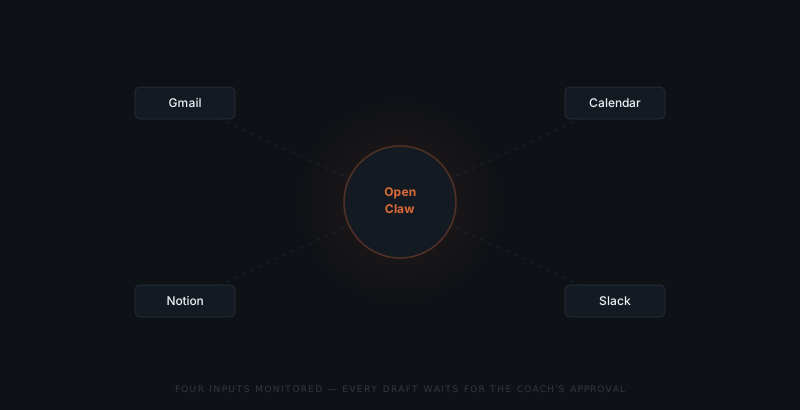
OpenClaw connects to the inbox and the client tracker. OpenClaw monitors each client's contact interval, session notes, and any commitments logged after the last session.
When a client reaches the check-in window without contact, OpenClaw drafts the message. When a session produces a follow-up action, OpenClaw queues a timed summary. When a client hits a milestone recorded in the tracker, OpenClaw drafts the acknowledgement.
| Trigger | What OpenClaw drafts |
|---|---|
| Check-in lapse | A between-session touchpoint when a client has not been contacted beyond the defined interval |
| Post-session follow-up | A summary or accountability message sent within 24 hours of a session |
| Milestone message | A note when a client reaches a goal or commitment recorded in the session tracker |
| Resource share | A message delivering a relevant resource when the client's current focus matches |
The approval step before any client contact
OpenClaw monitors client intervals and drafts the follow-ups — but OpenClaw does not contact clients automatically. Every draft surfaces in the Slack approvals channel before it reaches anyone. The coach approves, edits, or dismisses. Nothing sends without that sign-off. That constraint is enforced at the infrastructure level — there is no configuration that allows OpenClaw to send on its own.
Coaching relationships require more than accurate timing. A client mid-crisis needs a different message than a client who is coasting. OpenClaw cannot make that distinction. The coach can.
A resource share queued for last week might not fit where the client is today. A post-session summary drafted with yesterday's notes might need to account for a conversation that happened this morning. The coach sees the draft and the context in Slack. The coach decides.
Approvals for a 15-client practice take 10–15 minutes per week. The coach reviews the queue, approves what fits, and edits or dismisses what needs adjustment.
What a coaching week looks like with OpenClaw running
The session sets the direction. The follow-up is what keeps them moving.
Monday: three clients had sessions last week. OpenClaw has drafted a post-session summary for each. The coach approves two and edits the third before the morning's first call.
Wednesday: one client is four days past the agreed check-in window. OpenClaw has drafted the touchpoint. A second client hit a milestone from last session's notes — OpenClaw has drafted the acknowledgement. Both appear in Slack during the mid-week check.
Friday: a client mentioned a recurring pattern two sessions ago. OpenClaw has queued a resource share relevant to that pattern. The coach reviews and approves.
Five approvals. Fifteen minutes.
What coaches keep doing themselves
OpenClaw handles the timing and the drafting. Coaches keep the judgment calls.
Session design — what to explore in the next session based on what the client brought this week — stays with the coach. Goal recalibration, when a client's priorities shift, requires the coach's read on the relationship. Conversations that escalate — a client in crisis, a retainer that needs restructuring — never enter the draft queue.
OpenClaw handles the between-session communication that is timely, relevant, and repetitive. Coaches handle the communication that requires a judgment the session notes cannot provide.