| Task | What OpenClaw handles |
|---|---|
| Research | Structured web and document research, delivered as a summary |
| Deliverables | First draft from your notes and context, ready for your review |
| Meeting prep | Threads, docs, and calendar notes pulled before each call |
| Invoice follow-up | Monitors outstanding invoices, surfaces draft reminders |
| Knowledge base | Stores and retrieves context semantically across engagements |
| Recurring admin | Reports and summaries on a configured schedule |
Research without the tab sprawl
OpenClaw runs structured research across the web, synthesizes what it finds, and delivers a summary — without you opening a browser. It searches across multiple sources, fetches full page content, reads PDFs up to twenty pages at a time, and pulls from Google Drive documents you already have. Drop a client brief or an industry report into the conversation and ask it to extract the key points. It does.
For ongoing research needs, set the agent to monitor a topic, a competitor, or an industry trend and deliver a weekly briefing on a fixed day. You stop looking. It surfaces what changed.
From notes to deliverable
Most consulting deliverables start from the same place: a set of notes, a conversation, or a rough outline. OpenClaw takes that input and drafts the document — a proposal, a report structure, a slide outline — using gathered research and prior client context.
The time you save is in the initial draft — which for a longer deliverable can be several hours.
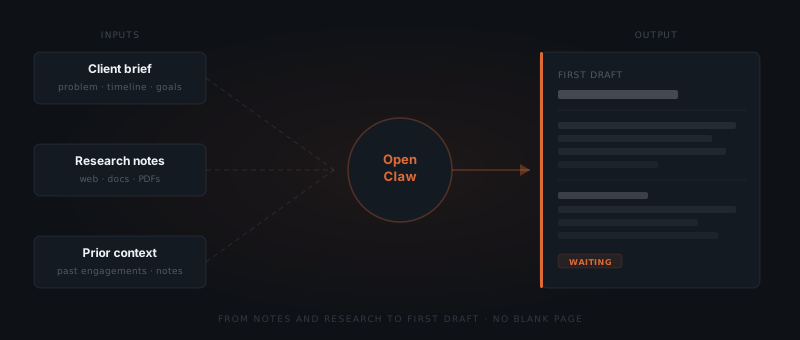
The drafting process stays under your control. Each version comes back for review before anything leaves. You refine, it applies the changes, you approve the final version.
Every meeting with full context
Before a client call, OpenClaw pulls together: prior session notes, outstanding items, the client's last message, and today's calendar. It delivers a summary before the meeting starts — sourced from your Gmail threads, Google Drive documents, and calendar notes.
After the meeting, paste in the notes or a transcript and ask it to structure them. It extracts action items, formats the summary, and stores it against the client so the context is there next time. The archaeology of finding what happened last quarter takes seconds instead of fifteen minutes.
Invoice follow-up that actually happens
For most independent consultants, invoice follow-up is the task that gets quietly skipped when the week gets busy. It is awkward, it takes time, and by the time you remember, the invoice is sixty days old. OpenClaw monitors your inbox for payment-related emails and flags anything that needs attention.
Set it on a schedule. If an invoice is unpaid after a set number of days, it drafts the follow-up and surfaces it for approval. You review and send, or edit and send, or decide to wait. Nothing goes out without your sign-off. The writing and the remembering are handled.
A knowledge base that builds across engagements
OpenClaw stores context persistently across conversations. Per-client agents keep each engagement's history separate, but the system can surface cross-client patterns when you ask.
Ask it what you found out about a topic six months ago and it retrieves the relevant notes. The search is semantic — you do not need to remember the exact wording. The knowledge you build doing the work accumulates in a form you can actually query.
Research from a prior engagement on a similar topic is findable. Context from an industry you have worked in before is not lost between projects.
Recurring admin on a schedule
Anything on a predictable cadence — status reports, weekly summaries, utilization tracking, billing reviews — runs on OpenClaw's built-in scheduler. Set it once. It runs at the time you specified, delivering output to Slack or email.
This is not about removing judgment from the work. It is about removing the overhead of remembering to do routine things at the right time. The output still comes to you for review. You are reviewing it instead of producing it.