Your store's data without the dashboard
OpenClaw connects to Shopify and answers questions about your store from whichever channel you use. Ask for today's orders, a customer's order history, current stock levels, or yesterday's revenue — it retrieves it without you logging in.
Set up a daily summary. Orders placed, revenue, returns initiated, low-stock flags — all pushed to Slack or WhatsApp at a time you set. You start the day knowing what happened overnight instead of opening four tabs to find out.
Customer support without the volume
Support tickets follow predictable patterns. Order status questions, shipping delays, return requests, wrong items — most have the same shape. OpenClaw pulls the relevant order data, drafts a response, and surfaces it for your approval before anything goes to the customer. You review and send, or edit and send.
For higher-risk actions — issuing a refund, applying a discount, modifying an order — the approval step is enforced at the infrastructure level. The agent cannot take those actions without your explicit sign-off.
One wrong refund on a high-volume day is expensive. The approval layer is not a setting you can accidentally leave off — it is a structural constraint. The action is blocked until you release it.
Inventory alerts before you run out
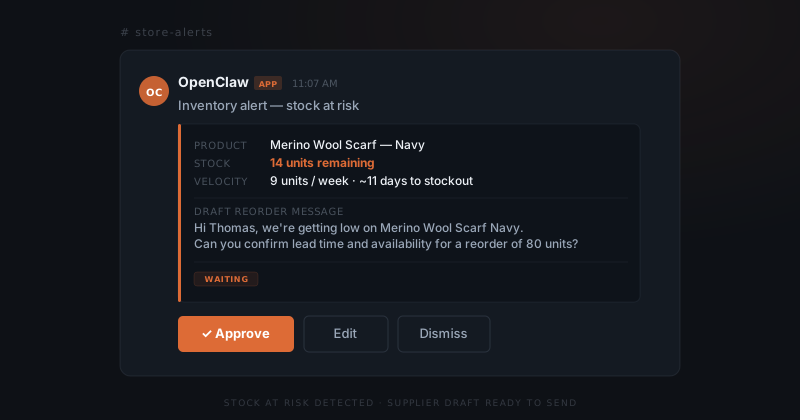
Static low-stock thresholds miss the point. A product with fifty units in stock is fine if it sells two a week and critical if it sells thirty. OpenClaw monitors inventory against actual sales velocity and alerts when stock is genuinely at risk.
| Alert level | When it triggers | What surfaces |
|---|---|---|
| Heads-up | Approaching reorder point | Product name, current stock, sales rate |
| Flag | Crossed reorder point | Supplier details + draft reorder message |
| Urgent | Out of stock | Immediate notification + draft customer comms |
At each stage, the agent surfaces the relevant supplier details and drafts a reorder message for your review. You approve it, it sends.
Returns that do not pile up
Returns are inevitable. What matters is how quickly you process them and whether you spot the patterns. OpenClaw triages incoming return requests, categorizes them by reason — sizing, quality, not as described, change of mind — and drafts the response. Standard cases get handled fast. Edge cases get flagged for you.
Over time, the categorization produces a picture of where returns are concentrated. If a specific product is generating repeated quality complaints, that surfaces as a pattern before it becomes a reviews problem. The data was always there — it just required someone to look at it consistently.
Revenue at a glance, every day
A daily revenue summary does not sound like much until you stop doing it manually.
OpenClaw pulls gross sales, net sales, orders, discounts, returns, and margin by channel — delivering a formatted summary to Slack or WhatsApp every morning. No dashboard, no export, no spreadsheet.
For multi-channel operations — your own store plus marketplaces — the summary aggregates across sources. You see what is happening across the business in one place, every day, without building a reporting workflow.
Product descriptions without the writing block
Writing product descriptions takes more time than it should. OpenClaw generates them from basic product data — name, category, attributes, materials — in your store's tone and format. You review, edit if needed, and publish.
For new product launches or catalog expansions, this removes most of the writing overhead. The agent produces a first draft; you make it yours. The time saved on a catalog of fifty new SKUs is significant.